
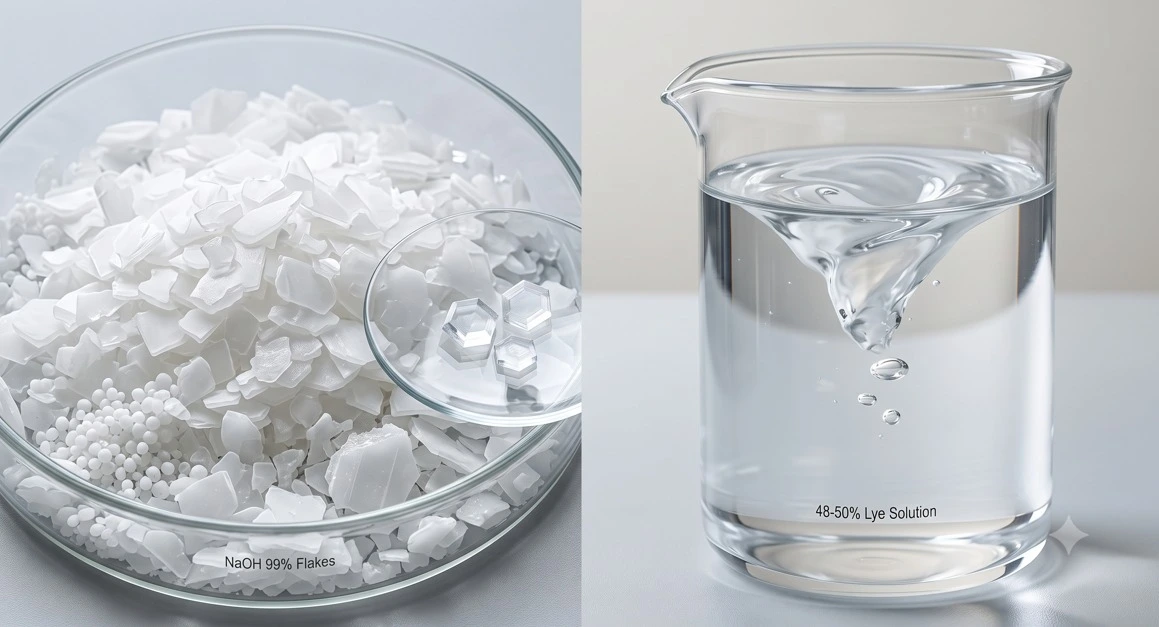
Caustic soda flakes and caustic soda lye are the same chemical, sodium hydroxide (NaOH). Flakes are solid at about 98 to 99% NaOH, while lye is a water solution at 48 to 50% NaOH. Buy flakes for manual handling and dry storage, and lye if your plant has liquid dosing. Compare prices per kg of actual NaOH, not per kg of product.
Need caustic soda flakes or lye? Send the grade and quantity on WhatsApp to +91 96777 61505 or +91 63790 09302.
Same Chemical, Two Forms: What Actually Changes
When comparing caustic soda flakes vs lye, plant buyers often ask if they are purchasing two completely different raw materials. In reality, both products provide the identical chemical substance, sodium hydroxide, recognized globally under CAS Number 1310-73-2. In road transport and freight safety regulations, solid flakes carry UN Number 1823, while liquid solutions take UN Number 1824. In India, both products follow the quality standards defined in IS 252 for caustic soda purity. The genuine difference between caustic soda flakes and lye comes down to three practical factors: active chemical concentration, material handling procedures, and warehouse storage setup.
When looking at sodium hydroxide flakes vs liquid solution, the most obvious difference is water content. Solid flakes are concentrated chemical substance with nearly all moisture driven off during manufacturing. Liquid lye is a pre-dissolved solution containing roughly 48% to 50% active sodium hydroxide, with purified water making up the other half of the total weight.
Choosing between solid flakes and liquid lye decides your daily factory workflow. It determines whether your workers spend time manually cutting bags, lifting sacks, and managing dissolving heat, or simply turn on a dosing pump connected to an automated pipe system. Both forms deliver the same chemical results, but picking the wrong option creates extra labor expenses, unnecessary safety hazards, or unneeded equipment spending.
Caustic Soda Flakes at a Glance
A comparison of caustic soda flakes 98% vs lye 48% demonstrates why solid flakes remain the preferred choice for units without bulk liquid storage tanks. The material arrives as thin, white, translucent solid flakes that dissolve readily in water.
Key characteristics of solid flakes include:
- High active purity: Flakes provide an industrial purity of 98% or more active sodium hydroxide by weight.
- Safe packaging: Flakes arrive packed in 50 kg woven polypropylene bags with an inner polyethylene liner to block moisture.
- Commercial minimum order: Standard supply starts at 500 kg, which equals 10 bags, making it accessible for batch operations.
- Strong hygroscopic nature: Solid sodium hydroxide pulls water vapor from ambient air rapidly. When bags stay open in humid weather, flakes absorb moisture, cake together, and melt into liquid. They also react with carbon dioxide in the air to produce a crust of sodium carbonate.
- Dissolving heat release: Dissolving solid flakes into water creates a strong exothermic reaction. The liquid temperature can rise past 80 degrees Celsius in minutes. Mixing tanks must withstand high temperatures, and staff must stir continuously to avoid sudden boil overs.
Because flakes carry no added water weight, they are the most freight-efficient form for road transit. A single truckload of bagged flakes delivers almost twice as much usable chemical substance as a truckload of liquid lye.
Caustic Soda Lye at a Glance
Industrial caustic soda lye is a ready to use liquid solution containing 48% to 50% active sodium hydroxide by weight. The solution is clear, dense, and ready for immediate dosing into factory systems.
Key characteristics of caustic soda lye include:
- Standard concentration: Industrial grades deliver 48% to 50% active sodium hydroxide.
- Commercial packaging: Lye is supplied in 50 kg carboys, 250 kg barrels, 1,000-liter intermediate bulk containers, or bulk road tankers.
- Automation friendly: Lye requires no on site dissolving or mixing tanks. Operators pump it straight from containers through PVC, CPVC, or PVDF piping directly into process lines.
- Heavy liquid density: Industrial 48% lye has a specific gravity around 1.51 to 1.53 at 25 degrees Celsius, making it roughly fifty percent heavier than plain water.
Crystallisation Is a Cold-Climate Issue and Rarely Matters in Chennai
Plant engineers evaluating lye often ask about freezing and crystallisation temperatures. A 50% caustic soda solution begins to crystallise at 12 to 14 degrees Celsius. In cold northern industrial regions during winter, outdoor tanks and exposed pipelines require electrical heating tape and insulation to keep the liquid from solidifying into paste.
In southern industrial zones like Chennai, Manali, and Ambattur, freezing is almost never an issue. Ambient temperatures remain well above 20 degrees Celsius throughout the year. Manufacturing plants across Tamil Nadu store 48% and 50% lye in outdoor tanks and shaded godowns without needing heated jackets or insulated transfer pipes.
Cost Per kg of Actual NaOH: The Working Formula and Price Math
The most common mistake in chemical purchasing is comparing the gross invoice price of flakes directly to the invoice price of lye without accounting for water content. Because liquid lye is roughly half water, one kilogram of lye provides only half the chemical strength of one kilogram of solid flakes.
Chemical distributors do not publish fixed rate cards because raw material costs and chlor-alkali power tariffs fluctuate weekly. Actual purchase rates depend on the specific manufacturer batch and the order volume requested. To find the true commercial cost of sodium hydroxide, buyers must look past the gross invoice rate and calculate the active matter cost:
Cost per kg of Active NaOH = Quoted Gross Price per kg / Active NaOH Fraction
For caustic soda flakes containing 98% active material, divide the quoted price per kg by 0.98. For caustic soda lye containing 48% active material, divide the quoted price per kg by 0.48.
The comparative table below illustrates how gross invoice rates convert into actual chemical costs without relying on speculative price numbers.
| Product Form | Nominal Active Purity | Quoted Rate per kg Gross | Calculation Formula | True Cost per kg of Active NaOH |
| Caustic Soda Flakes | 98% NaOH | Current Quoted Rate | Quoted Rate / 0.98 | True Flakes Active Cost |
| Caustic Soda Lye | 48% NaOH | Current Quoted Rate | Quoted Rate / 0.48 | True Lye Active Cost |
| Caustic Soda Lye | 50% NaOH | Current Quoted Rate | Quoted Rate / 0.50 | True Lye Active Cost |
Looking only at the invoice rate makes liquid lye appear much cheaper because half of what you buy is water. However, dividing the gross rate by the active fraction reveals the true cost of usable sodium hydroxide molecules.
When you request a quote from an industrial caustic soda lye supplier chennai, review both the active chemical math and your internal plant expenses. If preparing solid flakes costs your facility additional manual labor, mixer electricity, and maintenance on dissolving tanks, buying pre-dissolved lye can deliver real operational savings.
Decision Table: Comparing Plant Operating Factors
Deciding between solid flakes and liquid lye depends on your monthly volume, available equipment, warehouse storage conditions, and worker safety rules.
| Operational Factor | Caustic Soda Flakes (98%) PNG | Caustic Soda Lye (48% to 50%) PNG |
| Dosing Method | Manual bag cutting, measuring, dissolving | Automated metering pumps and flow loops |
| Minimum Equipment Needed | Stainless steel or FRP dissolving tank, agitator | Chemical metering pump, day tank, piping |
| Storage Requirements | Dry enclosed godown, moisture proof pallets | Bunded liquid storage area, carboy stands |
| Labor Demand | High: physical bag lifting, handling, dissolving | Low: closed loop pumping directly to process |
| Dust and Inhalation Risk | Present during bag opening and pouring | None (dust free liquid) |
| Splash Hazard Risk | Low during dry storage, high during mixing | Present whenever connecting transfer hoses |
| Inbound Freight Cost | Low per kg NaOH (no water transported) | Higher per kg NaOH (transporting 50% water) |
| Best Monthly Volume | 500 kg to 3,000 kg | 3,000 kg and above |
Facilities with small monthly usage or limited capital equipment usually prefer solid flakes because bags can be stacked in a dry godown without building storage bunds. Large facilities running continuous lines find automated liquid feeding cuts enough labor hours to outweigh any extra freight cost.
1 kg of Flakes Equals About 2 kg of 48% Lye: Conversion Table
When a plant switches from solid flakes to liquid lye, the batch recipe must be adjusted to account for the difference in active concentration.
Because 48% lye contains less than half the active alkali of flakes, you need about 2.04 kg of 48% lye to match the chemical strength of 1.0 kg of 98% flakes:
1.0 kg Flakes at 98% purity = 0.98 kg active NaOH
0.98 kg active NaOH / 0.48 purity in lye = 2.04 kg of 48% Lye
The conversion table below shows exact recipe adjustments across standard industrial batch sizes.
| Required Active NaOH | Equivalent Caustic Soda Flakes (98%) | Equivalent Caustic Soda Lye (48%) | Volume of 48% Lye (Litres at SG 1.52) |
| 10 kg | 10.2 kg | 20.8 kg | 13.7 Litres |
| 25 kg | 25.5 kg | 52.1 kg | 34.3 Litres |
| 50 kg (1 Bag) | 51.0 kg | 104.2 kg | 68.6 Litres |
| 100 kg | 102.0 kg | 208.3 kg | 137.0 Litres |
| 500 kg (10 Bags MOQ) | 510.2 kg | 1,041.7 kg | 685.3 Litres |
| 1,000 kg | 1,020.4 kg | 2,083.3 kg | 1,370.6 Litres |
Keep in mind that 48% caustic soda lye is much heavier than water. One litre of 48% lye weighs about 1.52 kilograms. If your plant workers measure liquids by volume using dipsticks or buckets rather than floor scales, always calculate weight to volume accurately to keep chemical reactions balanced.
Handling Differences: Dissolving Heat and Safety Rules
Both solid flakes and liquid lye are Class 8 corrosive substances. Contact with skin causes severe chemical burns, and eye contact can cause irreversible damage. Each form presents distinct handling risks during daily operations.
Working with Solid Caustic Soda Flakes
The main safety risks when using flakes occur while opening sacks and dissolving solids in tanks:
- Caustic dust hazards: Slicing open bags and dumping flakes releases fine alkaline dust into the air. This dust irritates eyes, nose, and throat. Operators must wear particulate dust respirators, chemical splash goggles, and rubber gloves.
- Rapid steam generation: Mixing flakes into water releases sudden heat. If an operator dumps too many flakes into standing water without good stirring, heat gathers at the bottom of the tank. The trapped water turns into steam, spitting hot caustic liquid out of the vessel.
- Proper dissolving technique: Always add solid flakes slowly into cold or room temperature water while stirring continuously. Never pour water over dry flakes.
Working with Liquid Caustic Soda Lye
Liquid lye removes the hazard of breathing chemical dust and eliminates dissolving tanks. However, handling pre-mixed liquid brings distinct fluid hazards:
- Pressurised splash hazards: Worn pump gaskets, loose pipe flanges, or damaged transfer hoses can spray liquid under pressure. Emergency eye wash stations and safety showers must be placed near all pumping points.
- Drum handling strain: Moving 50 kg carboys or 250 kg barrels manually causes physical strain and risks spills. Plants should provide mechanical drum lifters and barrel trolleys.
- Secondary containment: Storage carboys and bulk tanks must sit within concrete containment bunds capable of holding 110% of the largest tank volume to contain accidental leaks.
For both forms, workers must wear chemical aprons, face shields, rubber boots, and chemical resistant gloves during handling.
Which Industries Usually Buy Which Form
Industrial buyers across Tamil Nadu and neighbouring manufacturing belts select their caustic soda form based on production scale and processing needs.
Soap and Detergent Manufacturing
Small and medium soap makers and detergent units often purchase caustic soda flakes. These facilities run batch processes where dry ingredients are weighed out on scales to saponify vegetable fats or neutralize acid slurry. Bagged material allows operators to manage inventory without investing in bulk tanks. Larger detergent plants with automated dosing systems prefer bulk lye to run continuous production without manual bag opening.
Textile Wet Processing and Mercerising
Textile processing houses in Tirupur and Erode use large quantities of sodium hydroxide to swell cotton fibers, boost dye absorption, and improve fabric strength during mercerising. High capacity textile mills buy liquid lye in carboys or tankers. Because mercerising machines require a steady feed of alkaline liquor, pumping lye straight from storage saves significant labor and avoids the continuous chore of dissolving bags every shift.
Pulp and Paper Mills
Paper manufacturing plants use sodium hydroxide for wood pulping, removing lignin, and bleaching pulp fibers. Because paper mills use high chemical volumes every day, they buy caustic soda lye delivered in road tankers. Unloading directly into bulk storage keeps raw material pricing low and removes the chore of disposing of thousands of empty plastic bags.
Effluent Treatment Plants and pH Adjustment
Industrial wastewater facilities at metal finishing units, tanneries, and chemical plants use sodium hydroxide to neutralize acid waste and precipitate heavy metal contaminants.
Facilities with automated continuous flow effluent treatment systems prefer 48% lye because dosing pumps connect directly to automated pH sensors. Smaller effluent treatment plants that treat wastewater in occasional batches often purchase flakes, dissolving small quantities as each batch requires.
Sourcing and Supply from Velonex Chemicals
Velonex Chemicals is a chemical distributor in Redhills, Chennai supplying caustic soda flakes (50kg HDPE sack) and caustic soda lye (50kg HDPE carboy). Sourced from Chemplast Sanmar, Rayalaseema, and DCW, all products meet a minimum purity benchmark of 98% for flakes and 48% to 50% for lye. Batch-specific COA and MSDS with every order. Delivery in Chennai within 24 hours and 2 to 3 days elsewhere across Tamil Nadu and other states.
Every batch we supply satisfies strict industrial purity benchmarks, with a standard minimum order quantity of 500 kg (10 bags) for flakes and equivalent commercial volumes for lye.
Whether your plant needs bulk truckload supply or advice on switching from manual bags to automated liquid dosing, explore our complete range of industrial products to examine technical specifications. To discuss contract rates, confirm manufacturer batches, or arrange a scheduled chemical dispatch to your godown, contact our team through the contact us page or message our sales desk on WhatsApp.
Frequently Asked Questions
1. Is caustic soda flakes the same as lye?
Yes, both are physical forms of sodium hydroxide (NaOH). Flakes are dry solid particles with 98% to 99% active concentration. Lye is a water solution containing 48% to 50% sodium hydroxide. Both provide the exact same chemical properties in manufacturing processes.
2. Which is cheaper, flakes or lye?
Per delivered gross kilogram, liquid lye appears cheaper because it contains roughly 50% water. However, when measured by cost per kilogram of pure active NaOH, both forms generally cost a similar amount. Lye becomes more cost-effective when your plant can eliminate manual dissolving labor and reduce handling overhead through automated dosing systems.
3. How much lye equals 1 kg of flakes?
Approximately 2.04 kg of standard 48% caustic soda lye equals 1.0 kg of 98% caustic soda flakes. Because 48% lye has an approximate specific gravity of 1.52, this weight corresponds to roughly 1.34 litres of liquid solution for every kilogram of solid flakes replaced.
4. Can caustic soda lye freeze or crystallise?
Standard 50% caustic soda lye begins to freeze and crystallise at roughly 12 to 14 degrees Celsius. In warm southern regions like Chennai, ambient plant temperatures remain comfortably above this threshold throughout the year, so heated tanks and insulated transfer lines are rarely needed.
5. Which form is better for a small detergent unit?
For small scale detergent and soap manufacturing units, caustic soda flakes are typically the better choice. Flakes do not require dedicated liquid storage tanks, secondary containment bunds, or expensive chemical metering pumps. Solid 50 kg bags can be easily stored in dry godowns and weighed manually as needed for each batch.
Need caustic soda flakes or lye? Send the grade and quantity on WhatsApp to +91 96777 61505 or +91 63790 09302.
