
Bleaching Powder for Water Disinfection: Dosage Table, Available Chlorine, and Storage in Chennai Heat and Humidity
Water treatment plant operators, facility engineers, municipal contractors, and housing community managers rely on bleaching powder as a proven, dependable disinfectant. Known chemically as calcium hypochlorite Ca(OCl)₂, this chlorinated compound is the foundation for safeguarding raw water supplies, sanitizing overhead tanks and underground sumps, controlling biological growth in commercial swimming pools, and treating effluent discharge at sewage treatment plant (STP) outfalls.
Achieving consistent microbial kill without causing harsh smells, excess chemical sludge, or regulatory violations requires technical discipline. Process teams need to know how to calculate exact dosing based on tested available chlorine, how to account for contact time and raw water chlorine demand, and how to protect inventory from the degrading effects of coastal heat and humidity.
Understanding Available Chlorine and Why It Dictates Dosing
The term available chlorine represents the total oxidizing and disinfecting capacity of calcium hypochlorite relative to pure elemental chlorine. Freshly manufactured technical grade bleaching powder is standardized to yield between 30% and 35% available chlorine.
This percentage is not a static number. Calcium hypochlorite naturally reacts over time, venting trace chlorine while drawing in ambient moisture and carbon dioxide. For that reason, assuming an arbitrary strength percentage during compounding leads to two common failure states:
- Underdosing: Using an assumed 35% value when aged stock has dropped to 28% leaves water insufficiently disinfected. Pathogens, coliform bacteria, and viral contaminants survive, risking disease transmission and non-compliance with municipal drinking water standards.
- Overdosing: Applying calculations for weaker stock to a fresh, potent consignment releases excess free chlorine. This causes strong chemical taste, pungent fumes, accelerated corrosion of downstream plumbing fixtures, and the elevated formation of regulated disinfection byproducts such as trihalomethanes.
Velonex Chemicals supplies technical grade bleaching powder with an exact Certificate of Analysis (COA) issued by the manufacturing plant and pinned directly to the invoice for every batch. Plant chemists must reference the specific available chlorine value printed on that batch COA to set their chemical feed rates accurately.
Field Dosing Calculations and the Universal Formula
Calculating the physical mass of powder required to sanitize a given volume of water requires three operational variables: the volume of the reservoir in kilolitres, the target chlorine concentration in milligrams per litre (or parts per million), and the available chlorine fraction confirmed on your batch documentation.
The standard formula is:
Mass of Bleaching Powder in grams = (Target Dose in mg/L × Water Volume in Kilolitres) / Available Chlorine Decimal Fraction. If a plant operator needs to establish a 2 mg/L target dose in a 1 kilolitre holding tank using bleaching powder tested at 33% available chlorine (0.33 decimal fraction), the equation runs:
(2 mg/L × 1 KL) / 0.33 = 6.06 grams of bleaching powder.
Multiplying this formula across standard municipal, commercial, and residential water containment systems provides predictable baseline dosing requirements.
Dosing Quantities across Common Tank Volumes at 33% Available Chlorine
- 1 KL Overhead Tank (1,000 Litres): A target dose of 1 mg/L requires 3 grams of powder; a target dose of 2 mg/L requires 6 grams; a target dose of 3 mg/L requires 9 grams; a target dose of 5 mg/L requires 15 grams.
- 5 KL Commercial Storage Tank (5,000 Litres): A target dose of 1 mg/L requires 15 grams; 2 mg/L requires 30 grams; 3 mg/L requires 45 grams; 5 mg/L requires 75 grams.
- 10 KL Apartment Sump (10,000 Litres): A target dose of 1 mg/L requires 30 grams; 2 mg/L requires 60 grams; 3 mg/L requires 90 grams; 5 mg/L requires 150 grams.
- 50 KL Community Ground Reservoir (50,000 Litres): A target dose of 1 mg/L requires 150 grams; 2 mg/L requires 300 grams; 3 mg/L requires 450 grams; 5 mg/L requires 750 grams.
- 100 KL STP Outlet Clarifier (100,000 Litres): A target dose of 1 mg/L requires 300 grams; 2 mg/L requires 600 grams; 3 mg/L requires 900 grams; 5 mg/L requires 1,500 grams.
When working with batches tested at 30% available chlorine, dividing by 0.30 increases the physical mass by 10%. When running high-test stock at 35% available chlorine, dividing by 0.35 reduces the gross powder requirement, saving raw material inventory over continuous treatment cycles.
Contact Time, Residual Chlorine Standards, and Chlorine Demand
Dosing chlorine into water does not achieve instant sterile conditions. Disinfection is a kinetic chemical reaction governed by contact time, pH, temperature, and water impurities.
The 30 Minute Contact Rule
According to CPHEEO (Central Public Health and Environmental Engineering Organisation) design guidelines and Indian Standard IS 10500 drinking water specifications, chlorine requires a minimum retention contact time of 30 minutes in the water stream before that water is pumped to end consumers or released from an industrial facility. This holding period gives hypochlorous acid sufficient exposure time to penetrate bacterial cell walls, oxidize viral envelopes, and deactivate harmful organisms.
IS 10500 mandates a minimum free residual chlorine concentration of 0.2 mg/L at consumer distribution points. During monsoon weather, system flushes, or distribution repairs, local health authorities frequently recommend raising free residual levels to 0.5 mg/L to maintain active protection throughout distribution piping.
Factoring in Raw Water Chlorine Demand
A common operational error is assuming that adding 2 mg/L of chlorine yields 2 mg/L of free residual chlorine. Raw water drawn from borewells, surface reservoirs, or secondary wastewater clarifiers contains naturally occurring organic matter, dissolved iron, hydrogen sulphide, nitrites, and ammonia compounds.
These oxidizable substances consume chlorine instantly in non-disinfecting side reactions. The volume consumed before a durable residual appears is termed the chlorine demand.
Total Chlorine Dose = Chlorine Demand + Desired Free Chlorine Residual
If incoming raw water exhibits a chlorine demand of 1.6 mg/L, feeding a 2.0 mg/L dosage leaves only 0.4 mg/L as active free residual. Operating personnel must periodically run jar tests or test initial free residual levels to calculate true source demand, adjusting physical dosage upwards when raw water turbidity or organic contamination spikes.
The Correct Supernatant Slurry Dosing Technique
Technical grade calcium hypochlorite is manufactured through the chlorination of hydrated lime. As a result, the finished powder contains non-reactive calcium hydroxide and calcium carbonate binders that do not dissolve in water.
Dumping dry bleaching powder directly into a sump, tank, or clarifier channel is poor practice. The heavy insoluble lime sinks directly to the floor, forming thick sediment that clogs discharge lines, chokes submersible pump strainers, and clouds the treated water.
To implement clean, trouble-free dosing:
- Measure the exact mass of bleaching powder calculated for the batch volume into a clean, dedicated HDPE bucket filled with water.
- Stir the solution vigorously with a non-reactive paddle for several minutes to dissolve the soluble calcium hypochlorite, transferring active chlorine into the aqueous phase.
- Allow the slurry to rest undisturbed for 15 to 20 minutes. The dense, insoluble lime carriers settle quickly to the bottom, leaving a transparent chlorine solution above.
- Carefully decant only the clear top liquid into the water treatment tank or chemical dosing reservoir.
- Empty the inert white lime sludge at the bottom of the bucket into solid disposal waste.
Comparing Chlorine Disinfection Alternatives
Facilities evaluate calcium hypochlorite alongside two primary industrial alternatives: liquid sodium hypochlorite and stabilized dry trichloroisocyanuric acid (TCCA 90).
Bleaching Powder vs Sodium Hypochlorite
Sodium hypochlorite is delivered as an aqueous yellow solution typically containing 10% to 12% available chlorine. Its primary benefit is that it contains zero insoluble lime, eliminating tank sedimentation and allowing direct metering through automated dosing pumps. However, liquid hypochlorite is unstable. In warm climates, it degrades rapidly into sodium chloride and sodium chlorate, venting oxygen and losing active strength within weeks. Furthermore, because it ships as an 88% water solution, transport logistics and drum handling costs run substantially higher per unit of delivered chlorine. Technical bleaching powder remains a durable dry solid that retains shelf stability longer when stored properly.
Bleaching Powder vs TCCA 90
Trichloroisocyanuric acid (TCCA 90) contains approximately 90% available chlorine and is formulated with cyanuric acid, which acts as a built-in ultraviolet stabilizer. While TCCA tablets work exceptionally well in outdoor commercial swimming pools where direct sunlight breaks down unbonded chlorine, cyanuric acid builds up continuously in closed circuits. TCCA also carries a higher raw material price point. For large-scale drinking water schemes, municipal distribution, and industrial wastewater neutralization, standard calcium hypochlorite provides reliable disinfection at significantly lower treatment cost.
Storage Protocols for High Heat and Humidity in Chennai
Chennai and broader industrial belts across Tamil Nadu present demanding storage conditions due to elevated ambient temperatures and coastal humidity. Calcium hypochlorite is classified under international transport and warehouse safety standards as UN 2208, Class 5.1 (oxidizer) with a subsidiary Class 8 (corrosive) hazard.
Improperly stored bleaching powder degrades, losing available chlorine into the atmosphere, corroding nearby steel structures, and creating safety risks. Warehousing facilities should implement strict handling controls:
- Moisture Protection: Bleaching powder is hygroscopic. It absorbs atmospheric water vapor readily, causing the dry material to cake, heat up, and release hazardous chlorine gas. Bags must be stacked off bare concrete floors on wooden or heavy plastic pallets, inside dry, covered warehouses protected from roof leaks and rain entry.
- Liner Integrity: Once an HDPE woven sack is opened, workers must securely re-tie the inner poly liner immediately after scooping material. Leaving open sacks exposed to ambient air leads to rapid chlorine loss.
- Segregation from Acids and Ammonia: Bleaching powder must never be stored alongside hydrochloric acid, sulphuric acid, nitric acid, or cleaning formulations containing ammonia. Direct contact with acids triggers immediate, violent generation of toxic chlorine gas.
- Isolation from Combustibles and Organic Matter: As a powerful Class 5.1 oxidizing agent, calcium hypochlorite donates oxygen rapidly to support combustion. Keep all sacks strictly segregated from lubricating oils, diesel containers, grease, sawdust, solvent rags, and organic cleaning bases to prevent fire risks.
- Ventilation and PPE: Warehouses must provide cross-ventilation to prevent chlorine vapor buildup. Handlers should wear protective PVC gloves, chemical splash goggles, and dust respirators during dispensing to avoid skin and mucous membrane burns.
Sourcing Verified Chlorine Stock for Industrial Operations
Dosing accuracy depends on reliable raw material supply. Using bleaching powder with erratic available chlorine percentages disrupts standard operating procedures, requiring constant manual adjustments to feed systems.
Velonex Chemicals supplies technical grade bleaching powder testing consistently at 30% to 35% available chlorine. Dispatched from Vadaperumbakkam, Chennai, stock is packaged in durable 25 kg and 50 kg moisture-resistant laminated bags, backed by a 500 kg minimum order quantity suited for bulk municipal tenders, housing society maintenance, and plant operations. Consignments arrive with manufacturer batch-specific COAs, supported by 24-hour delivery across Chennai and rapid 2 to 3 day distribution across Tamil Nadu and neighbouring states.
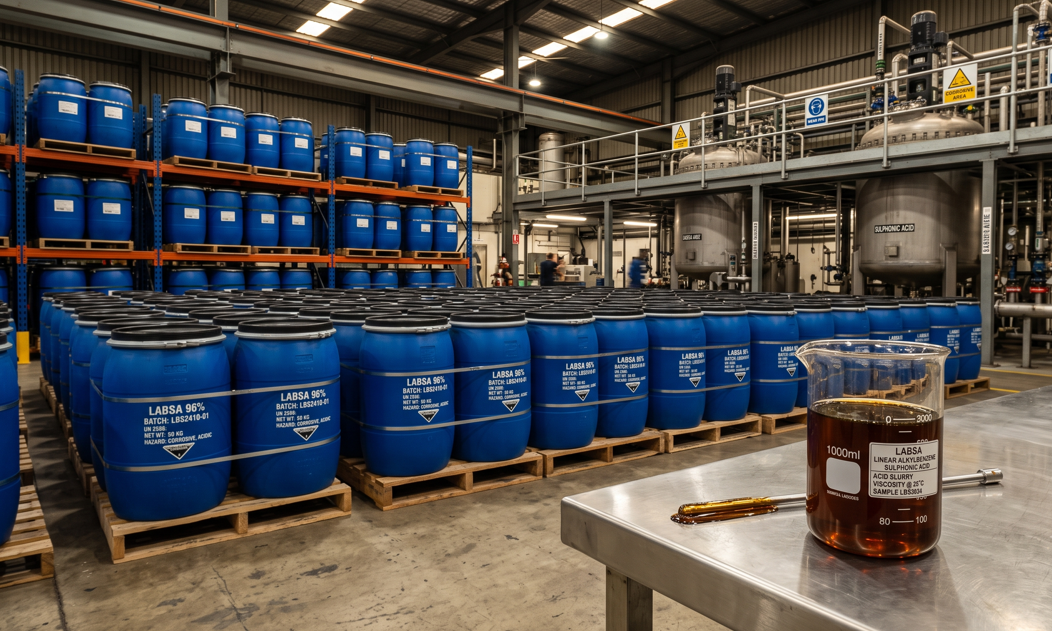
Acid Slurry (LABSA) 90% vs 96%: Active Matter, Neutralisation Maths, and Cost per Kilo of Active
Linear Alkylbenzene Sulphonic Acid, universally traded as acid slurry or LABSA, is the core anionic surfactant powering the global detergent and cleaning chemical manufacturing sectors. Derived from the sulphonation of linear alkylbenzene, LABSA delivers strong wetting, emulsifying, foaming, and soil-suspending performance across domestic laundry powders, industrial degreasers, vehicle washes, dishwashing bars, and liquid cleaners.
When purchasing acid slurry, manufacturing directors, procurement heads, and plant chemists face a consistent formulation choice: whether to standardize their production line on 90% active matter slurry or upgrade to high-purity 96% active matter slurry. Choosing between the two requires understanding the chemical differences, the exact caustic soda required to neutralize each grade, the real cost per kilo of active surfactant, and the formulation impact on powder and liquid detergent lines.
Decoding Active Matter: What Comprises the Liquid
Commercial acid slurry is not a pure single-component material. The active matter specification defines the percentage of pure alkylbenzene sulphonic acid molecules present in the drums. The remaining percentage comprises reaction byproducts, unreacted starting materials, and trace process water.
The Composition of LABSA 90%
LABSA 90% is the long-standing industry standard across traditional detergent powder and cleaning compound production. A typical batch contains:
- 90% Active Anionic Surfactant: Linear alkylbenzene sulphonic acid.
- 5% to 7% Free Sulphuric Acid: Residual inorganic acid carried over from the sulphonation process.
- 1.0% to 1.5% Unsulphonated Matter: Unreacted neutral linear alkylbenzene hydrocarbons (free oil).
- Balance Moisture: Process water keeping the liquid workable.
In dry washing powder compounding, the free sulphuric acid present in 90% slurry is fully utilized. During neutralisation with soda ash or caustic soda, this sulphuric acid reacts to form sodium sulphate in-situ inside the mixer. Because sodium sulphate serves as an industry-standard inorganic builder, bulking agent, and processing aid that improves the free-flowing characteristics of washing powder, 90% slurry provides both surfactant and builder in a single raw material charge.
The Composition of LABSA 96%
LABSA 96% represents a concentrated, modern surfactant grade produced in advanced air-SO₃ falling film sulphonation reactors. Its composition features:
- Minimum 96% Active Surfactant: Delivering a denser charge of active cleaning power per kilogram.
- Maximum 1.5% Free Sulphuric Acid: Residual mineral acid is kept exceptionally low.
- Low Unsulphonated Matter: Residual neutral oils are minimized, preventing batch haze.
- Under 1.0% Moisture: Highly concentrated raw material.
Because 96% slurry eliminates excess free sulphuric acid, it generates minimal byproduct sodium sulphate upon neutralisation. This purity makes 96% slurry the preferred raw material for clear liquid formulations, such as transparent dishwashing gels, premium laundry detergents, and floor cleaners, where dissolved sodium sulphate lowers the solution cloud point, triggers salt precipitation, and causes haze at cool temperatures.
Neutralisation Chemistry: Flakes vs Lye
Unneutralized acid slurry is a dark brown, viscous acidic liquid with a pH below 2. In its acidic state, it possesses limited detergency and is corrosive to wash fabrics, skin, and processing machinery. To become a functional cleaning surfactant, it must be neutralized with an alkaline base, most commonly caustic soda (sodium hydroxide, NaOH) or dense soda ash (sodium carbonate, Na₂CO₃), converting the acid into active sodium linear alkylbenzene sulphonate (Na-LAS).
The neutralisation reaction is strongly exothermic, generating significant heat. If reaction heat is poorly controlled inside bulk mixing tanks, the surfactant solution can scorch, darkening the final product from light golden-amber to dull brown and degrading fragile fragrance oils.
In production, caustic soda neutralizes both the organic sulphonic acid and the inorganic free sulphuric acid:
Organic Neutralisation: R-SO₃H + NaOH → R-SO₃Na + H₂O (Yielding active surfactant)
Mineral Acid Neutralisation: H₂SO₄ + 2NaOH → Na₂SO₄ + 2H₂O (Yielding sodium sulphate byproduct)
Because 90% slurry carries more free sulphuric acid, each kilogram consumes additional caustic simply to neutralize that mineral acid.
Calculating Caustic Requirements per 100 kg Batch
Technical stoichiometry reveals the exact alkali mass needed to bring 100 kg of each slurry grade to a neutral pH of 7.0 to 8.0:
Neutralising 100 kg of LABSA 90%
- Neutralising 90 kg of sulphonic acid requires approximately 11.0 kg of 100% pure NaOH.
- Neutralising an average 5.5 kg of free sulphuric acid requires approximately 4.5 kg of pure NaOH.
- Total Pure NaOH: Approximately 15.5 kg of dry solid caustic soda flakes (100% basis).
- Using 48% Liquid Caustic Lye: 15.5 kg / 0.48 = approximately 32.3 kg of liquid caustic lye.
Neutralising 100 kg of LABSA 96%
- Neutralising 96 kg of sulphonic acid requires approximately 11.8 kg of pure NaOH.
- Neutralising an average 1.5 kg of free sulphuric acid requires approximately 1.2 kg of pure NaOH.
- Total Pure NaOH: Approximately 13.0 kg of dry solid caustic soda flakes (100% basis).
- Using 48% Liquid Caustic Lye: 13.0 kg / 0.48 = approximately 27.1 kg of liquid caustic lye.
Although LABSA 96% contains 6% more active sulphonic acid by weight, its lower free sulphuric acid content reduces overall caustic consumption by 2.5 kg of flakes (or 5.2 kg of lye) per 100 kg drum processed. This reduction lowers the chemical alkali cost required to bring the master batch to neutral.
True Commercial Cost per Kilo of Active Matter
Procurement teams comparing chemical quotes often focus exclusively on the drum invoice price per kilogram. However, buying detergent surfactants based purely on gross tonnage masks the underlying raw material economics.
Because a purchaser receives 900 grams of functional surfactant in a kilo of 90% slurry and 960 grams in a kilo of 96% slurry, financial evaluation must focus on the landed cost per kilogram of active matter.
Cost per Kilo of Active Surfactant = Landed Price per Kilo / Active Matter Decimal Fraction
When chemical distributors provide market quotes for both grades, calculating this ratio demonstrates real value:
- If 90% slurry carries a gross price of X per kg, the active cost is X divided by 0.90.
- If 96% slurry carries a gross price of Y per kg, the active cost is Y divided by 0.96.
Whenever the market price spread between the two grades narrows, 96% active slurry becomes the more economical choice on an active-unit basis. Furthermore, adopting 96% slurry delivers secondary logistics savings:
- Freight Reduction: Facilities transport less dead weight in the form of water and mineral acid across road networks.
- Packaging Efficiency: Fewer 50 kg carboys or 200 kg drums are required to warehouse the same net quantity of cleaning surfactant.
- Tank Space Optimization: Production sites maximize active surfactant inventory within existing chemical holding capacity.
Practical Steps for Formulation Adjustments
Switching a factory’s processing lines from 90% to 96% LABSA requires operational adjustments to avoid unbalancing existing recipes.
1. Re-scaling Charge Weight
Because 96% slurry is more concentrated, charging the identical gross weight will raise the finished product’s active surfactant content above label claims, inflating raw material consumption. Formulators should reduce the physical slurry charge weight by roughly 6.25% to keep active matter levels constant.
2. Trimming the Alkali Charge
As established in the neutralisation stoichiometry, 96% slurry contains significantly less free sulphuric acid. Maintaining the old caustic dosing will result in unreacted alkali, driving the batch pH alkaline (pH 10 to 12). Formulators must reduce the caustic soda or soda ash charge to avoid overshooting the target neutral range (pH 7.0 to 8.0).
3. Balancing Builders in Powder Formulations
In high-volume detergent powder processing, the drop in in-situ sodium sulphate formation when using 96% slurry must be compensated for. Adding pure commercial sodium sulphate powder restores mechanical bulking, flowability, and anti-caking properties in the drying tower or ribbon blender.
4. Managing Viscosity in Liquid Formulations
When producing liquid hand dishwash or laundry detergents, formulators commonly rely on byproduct sodium sulphate to build viscosity alongside secondary surfactants such as sodium lauryl ether sulphate (SLES) and cocamidopropyl betaine (CAPB). Because 96% slurry generates less byproduct salt, the unadjusted base may exhibit a thinner consistency. Formulators can easily rebuild rheology by dosing controlled amounts of industrial vacuum salt (sodium chloride) or liquid thickeners.
Storage, Workplace Safety, and Safe Handling
Acid slurry is an industrial chemical classified under transportation safety regulations as Class 8 Corrosive Liquid. Concentrated LABSA causes immediate irritation and chemical burns upon skin contact, and severe irreversible damage upon ocular exposure.
- Personal Protection: Operators dispensing or pumping acid slurry must wear heavy-duty PVC or nitrile gloves, full-coverage chemical splash goggles, protective rubber aprons, and steel-toe boots.
- Exothermic Safety: When adding caustic solutions to slurry, add the acid slowly into the agitated alkaline water phase under continuous cooling. Never reverse the order rapidly in unvented vessels, as boiling liquid can erupt from the vessel neck.
- Cold Weather Viscosity: Acid slurry thickens significantly as ambient temperatures drop below 20 degrees Celsius. Maintain drums in enclosed, dry storage areas away from direct cold drafts. If material stiffens inside the drum, gentle warming in an indirect hot-water jacket room restores fluid pumping viscosity.
- Separation from Bases: Store sealed drums strictly segregated from stored caustic flakes, liquid lye, hypochlorite bleaches, and concentrated oxidizing agents to eliminate unintentional exothermic contact.
Partnering with an Established Surfactant Distributor
Securing consistent batch performance requires an uninterrupted raw material supply with verified chemical parameters. Low-quality slurry containing excess unsulphonated oil impairs product foam profiles, while erratic acid values disrupt automated neutralisation lines.
Velonex Chemicals distributes industrial grade acid slurry (LABSA) in both 90% and 96% active matter grades. Sourced from established petrochemical manufacturers, inventory is available in heavy-duty 40 kg and 50 kg HM-HDPE carboys (minimum order quantity of 500 kg), up to bulk tanker loads for continuous production facilities. Every consignment is backed by a batch-specific COA and MSDS confirming active matter, free acid, and color values, with guaranteed 24-hour delivery inside Chennai and 2 to 3 day transit across Tamil Nadu and neighbouring states.
