
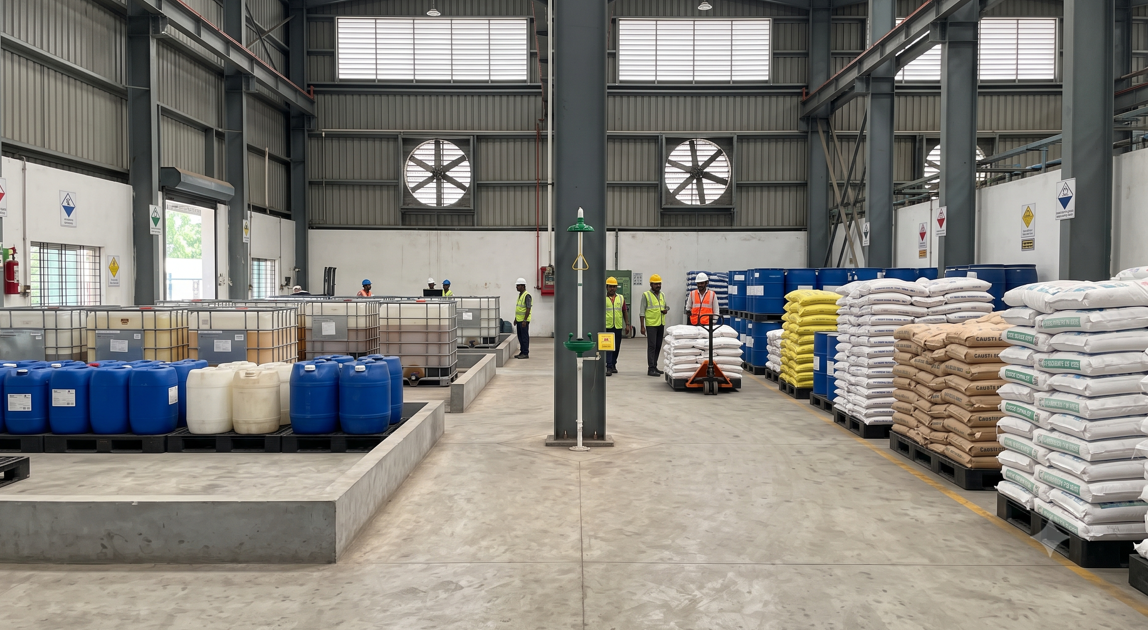
Managing an industrial chemical warehouse along the Coromandel Coast presents severe environmental challenges. Industrial clusters across Chennai, Thiruvallur, Sriperumbudur, Ambattur, and Manali face sustained ambient temperatures exceeding 40 degrees Celsius during peak summer, relative humidity levels hovering between 70% and 90% for most of the year, and torrential cyclonic downpours during the Northeast monsoon. For warehouse superintendents, plant managers, safety officers, and inventory controllers, environmental factors dictate storage architecture. Ambient humidity degrades hygroscopic dry chemicals, high ambient temperatures accelerate active ingredient loss in unstable compounds, and water ingress during heavy cloudbursts creates severe reaction hazards.
Adhering to verified chemical storage guidelines india requires an absolute understanding of chemical compatibility, secondary containment engineering, and strict climate-driven storage protocols. At Velonex Chemicals, industrial compounds are packaged and supplied directly to manufacturing facilities and processing units across Chennai and Tamil Nadu in robust, sealed industrial packs. Maintaining batch purity, operator safety, and regulatory compliance on site requires systematic segregation protocols and active shelf life management.
Chennai Climate Factors: Humidity and Caking, Heat and Available Chlorine Loss, Monsoon Flooding of Low Lying Godowns
Standard chemical warehousing manuals written for temperate zones fail to address the specific atmospheric realities of coastal Tamil Nadu. Storage practices must actively counterbalance three distinct environmental threats.
1. High Relative Humidity and Hygroscopic Caking
Coastal air carries intense moisture loads throughout the year. When bags of dry inorganic salts or solid alkalis are exposed to ambient moisture through micro punctures, torn liners, or open seams, rapid moisture absorption occurs.
- Solid chemicals such as caustic soda flakes, non ferric alum, soda ash, and calcium chloride absorb moisture until the outer crystal layers dissolve, forming dense clumps or liquid slurry.
- Caked materials cake solid inside woven sacks, plugging hoppers, damaging feed pumps, and producing inconsistent dosing concentrations in water treatment and manufacturing lines.
- Solid hygroscopic chemicals storage mandates continuous barrier isolation from ambient air.
2. Extreme Summer Temperatures and Thermal Decomposition
Between April and June, surface temperatures on standard corrugated metal sheet roofs often surpass 55 degrees Celsius, creating high internal warehouse temperatures without thermal insulation. Elevated heat destabilizes energetic or oxidizing chemical bonds:
- Bleaching Powder and Calcium Hypochlorite: High ambient temperature triggers spontaneous breakdown into calcium chloride, calcium chlorate, and oxygen gas, releasing toxic chlorine fumes.
- Sodium Hypochlorite Solutions: Liquid hypochlorite degrades logarithmically with temperature spikes. At temperatures above 30 degrees Celsius, sodium hypochlorite decomposes into sodium chlorate and sodium chloride, slashing available chlorine percentages within weeks.
- Hydrogen Peroxide Solutions: Heat acts as a primary catalyst for auto decomposition, liberating pure oxygen gas and expanding drums rapidly if ventilation vents are obstructed.
3. Monsoon Flooding in Low Elevation Industrial Corridors
The Northeast monsoon routinely drops hundreds of millimeters of rain within hours across low lying industrial catchments such as Manali, Madhavaram, and Redhills. Runoff backflow and flash flooding submerge unraised godown floors. Ground contact with storm runoff corrodes steel storage drums, dissolves paper and polypropylene bags, and unleashes uncontrolled exothermic reactions if water breaches bags of solid alkalis, water reactive materials, or concentrated acid carboys.
The Segregation Logic: Acids, Alkalis, Oxidisers, Organics and the Dangerous Pairs
Chemical segregation prevents accidental cross reactions during routine material transfers, handling incidents, or package failures. Storing chemicals alphabetically or grouping them merely by container size introduces severe structural hazards. Incompatible liquid spills must never cross paths.
The core chemical segregation matrix outlines fundamental compatibility rules across four major chemical families to prevent catastrophic storage reactions. Inorganic acids are strictly incompatible with caustic alkalis, strong oxidisers, and organic solvents. Mixing inorganic acids with alkalis triggers violent neutralization and dangerous exothermic heat spikes, while contact with oxidisers generates toxic gas releases and combining them with organic solvents introduces severe fire and explosion risks. Even within the acid family itself, mineral acids must be separated from organic acids. Caustic alkalis can be safely grouped with other compatible alkalis and are generally compatible with organic solvents provided fuel sources are segregated, but they must be kept strictly away from acids and restricted around oxidisers where dry and cool isolation is required. Strong oxidisers present extreme hazards and must never share space with acids or organic solvents, as oxidisers in contact with flammable organics create immediate explosion and detonation risks. Organic solvents and flammable liquids remain safely stored with one another using proper container grounding and bonding, yet they must remain completely segregated from both inorganic acids and strong oxidisers to eliminate severe chemical reactivity and fire dangers.
Critical Hazardous Chemical Combinations
Hydrochloric Acid with Sodium Hypochlorite or Bleaching Powder
Never store hydrochloric acid anywhere near chlorine releasing oxidisers. When acid contacts hypochlorite solutions or solid bleaching powder, instantaneous acidification produces copious amounts of dry chlorine gas (Cl2Cl_2Cl2). Chlorine gas is an acute respiratory hazard capable of incapacitating an entire facility within minutes.
Nitric Acid with Organic Solvents or Reducing Agents
Nitric acid is a potent mineral acid and a powerful oxidiser. When concentrated nitric acid contacts organic chemicals, timber pallets, oil lubricants, or flammable solvents, it triggers spontaneous hypergolic combustion or rapid overpressurization explosions. Nitric acid carboys require dedicated acid resistant containment bunds separate from general mineral acids.
Hydrogen Peroxide with Transition Metals and Alkalis
Hydrogen peroxide must remain isolated from rust particles, brass valves, copper piping, mild steel drums, and strong caustic solutions. Trace metal ions trigger catalytic runaway decomposition into boiling water and gaseous oxygen. An oxygen enriched atmosphere lowers the ignition energy of all nearby combustibles, turning minor sparks into major blazes.
Sulfuric Acid with Water and Caustic Lye
Mixing concentrated sulfuric acid with liquid caustic soda generates intense heats of solution. The reaction temperature easily exceeds the boiling point of water, throwing boiling caustic acidic mist across the storage bay.
Product Storage Guide for Industrial Formulations
Every industrial chemical requires dedicated storage parameters to safeguard active chemical concentration and prevent catastrophic container deformation. Review the full line of bulk chemicals, acids, and alkalis on our Velonex industrial products catalog to match incoming supplies with appropriate storage specifications.
| Chemical Name | Recommended Container | godown Ventilation Type | Incompatible Materials | Estimated Shelf Life in Chennai Climate | Core Climate Hazard |
| Caustic Soda Flakes (Sodium Hydroxide 99%) | Heavy duty 50 kg PP bags with intact LDPE internal liners | Low humidity dry storage with mechanical exhaust | Mineral acids, aluminium, zinc, organic halides, moisture | 12 to 18 months if seal remains airtight | Severe moisture absorption turning solid flakes into corrosive liquid |
| Hydrochloric Acid (Commercial Grade 30% to 33%) | Food grade HDPE carboys, rubber lined steel tanks, IBC totes | Continuous positive low level cross ventilation to clear fumes | Bleaching powder, sodium hypochlorite, strong alkalis, cyanide salts | 12 months in sealed UV stabilized containers | Vaporization of hydrogen chloride gas corroding roof purlins and structural steel |
| Bleaching Powder (Stable Grade 34% to 35%) | Air tight HDPE drums or sealed laminated composite bags | Cool, shaded dry bay away from heat; natural cross draft | All mineral acids, ammonia compounds, moisture, combustible matter | 3 to 6 months before available chlorine drops below trade grade | Accelerated thermal degradation causing drum bloating and loss of sanitizing power |
| Sodium Hypochlorite (Industrial Grade 10% to 12%) | Opaque UV stabilized HDPE carboys with vented breather caps | Well ventilated shaded yard or climate controlled room | Acids, organic matter, iron, copper, direct solar radiation | 30 to 45 days during summer; 60 days in winter | Rapid breakdown into chlorates and salt, liberating oxygen gas |
| Hydrogen Peroxide (Industrial Grade 35% to 50%) | Passivated HDPE carboys with operational degassing relief valves | Isolated cool bay, explosion proof ventilation, dust free | Heavy metals, iron rust, alkalis, strong acids, flammables | 6 to 12 months under 25 degrees Celsius | Catalytic runaway explosion and excessive drum pressure under high heat |
| Non Ferric Alum (Aluminium Sulphate solid) | Multi wall paper sacks with inner polythene liner or HDPE sacks | Standard ambient dry godown; roof protected from leaks | Strong bases, calcium hypochlorite, unlined carbon steel | 24 months if kept off concrete floors | Severe caking from monsoon humidity making dissolution sluggish |
| Soda Ash Light (Sodium Carbonate 99%) | Double wrapped laminated HDPE bags | Dry ambient storage, protected from damp breeze | Sulfuric acid, phosphorus pentoxide, ambient dampness | 18 months in unopened original packaging | Moisture absorption causing hard lump formation and weight variations |
Godown Layout Checklist: Structural Safety and Storage Architecture
A high performance chemical godown requires proactive engineering controls rather than passive floor stacking. Safety auditors inspecting storage operations throughout the industrial corridors of Redhills, Ambattur, and Guindy look for physical infrastructure built to mitigate coastal weather impacts.
Raised Plinths and Pallet Elevation
Never store bagged powdered chemicals or plastic carboys directly on unsealed concrete floors. Coastal soil moisture wicks upward through concrete capillary action, soaking the bottom row of bags within days.
- Mount all dry chemicals on heavy duty, chemical resistant polyethylene pallets raised at least 150 millimeters above floor height.
- Maintain a clearance buffer of at least 600 millimeters between bulk stacks and outer perimeter walls to allow air circulation and leak inspections.
- Design warehouse entry aprons with elevated ramp humps to prevent monsoon stormwater surges from inundating chemical bays.
Secondary Containment and Bunding
Corrosive liquids demand secondary containment engineered to catch 110% of the single largest container or 25% of the total aggregate stored liquid volume, whichever value is greater.
- Fabricate containment bunds from reinforced concrete lined with acid resistant epoxy or vinyl ester coatings.
- Segregate acid containment pits from alkali containment pits with non porous isolation curbing.
- Equip bund collection sumps with manual drainage cut off valves; secondary containment must never tie directly into general storm water culverts.
Controlled Mechanical and Gravity Ventilation
Thermal buildup under metal roofs converts godowns into reaction incubators.
- Install high capacity ridge ventilators combined with low level wall louvers to encourage natural stack effect cooling.
- For hydrochloric acid and volatile chemical bays, operate dedicated forced draft FRP exhaust fans positioned near floor level where dense corrosive vapors congregate.
- Protect all wall louvers and roof cowls with monsoon rain baffles and stainless steel mesh to block driving rain and pest intrusion.
Emergency Decontamination Stations
- Position self draining emergency eyewash and safety shower stations within a 10 second walking radius of all acid and alkali storage zones.
- Avoid routing primary water supply lines across uninsulated roof panels where solar heat boils stagnant supply water, which can cause thermal burns during emergency decontamination.
- Install continuous drain trays below emergency showers routed to on site effluent collection tanks.
Neutralizing Spill Kits
Maintain dedicated, visibly marked spill response lockers at warehouse exits.
- Stock acid spill stations with sodium bicarbonate, soda ash, and chemically inert polypropylene absorbent rolls.
- Stock alkali spill stations with dilute citric acid, dry sand, and non reactive absorbent pads.
- Never use combustible sawdust or wood shavings to clean up oxidizing liquids like nitric acid or concentrated hydrogen peroxide.
What Auditors Look For: Regulatory Compliance in Tamil Nadu
Industrial manufacturing and warehousing centers must conform strictly to statutory industrial safety frameworks. Plant owners, store supervisors, and godown operators are subject to regular inspections by the Tamil Nadu Directorate of Industrial Safety and Health (DISH), regional officers of the Tamil Nadu Pollution Control Board (TNPCB), and the Petroleum and Explosives Safety Organization (PESO).
Key compliance checkpoints include:
- Current and Accessible Safety Data Sheets: Every stored chemical must have an updated 16 section Safety Data Sheet (SDS) mounted at the entrance of the bay in both English and Tamil.
- Standardized Hazchem Signage: Clear, color coded chemical classification placards must mark every storage quadrant, displaying valid Hazchem codes, primary hazard diamonds, and emergency contact numbers.
- Compatibility Separation Distances: Auditors strictly monitor the physical isolation between incompatible materials. If shared storage sheds are utilized, physical fire walls or isolated secondary containment trenches must separate oxidisers, acids, and alkalis by a minimum clear buffer distance of 3 to 5 meters.
- Effluent Containment Measures: Facilities must prove that chemical leaks, wash water, or spent firefighting fluids cannot seep into municipal gutters or natural groundwater reservoirs.
- Worker PPE Protocols: Verification that operators possess neoprene gloves, face shields, rubberized chemical suits, and half mask respirators with organic vapor and acid gas filter cartridges.
Shelf Life and Stock Rotation (FIFO) for Unstable Compounds
In Chennai’s climate, chemical stability degrades predictably over time. Relying on disorganized batch management results in dead stock, off spec chemical dosing, and violent container swelling. Maintaining chemical potency demands rigorous First In, First Out (FIFO) discipline.
1. Liquid Sodium Hypochlorite Management
Fresh commercial sodium hypochlorite typically tests between 10% and 12% available chlorine. In ambient summer temperatures exceeding 35 degrees Celsius, available chlorine drops by 1% to 2% every two weeks.
- Order shipments in smaller, frequent batches sized for consumption within 14 to 21 days rather than holding bulk monthly inventory.
- Store carboys inside shaded, temperature stable masonry godowns away from open windows.
- Ensure all carboy lids contain operational micro porous degassing membrane vents to release oxygen gas while keeping dust out.
2. Bleaching Powder Handling
Stable bleaching powder should maintain a minimum of 33% available chlorine. In humid monsoon conditions, moist air accelerates the production of hydrochloric and hypochlorous acid within packaging, attacking inner liners.
- Reject bags arriving with hard interior cakes, surface sweating, or discolored outer packaging.
- Rotate pallets so older shipments leave the warehouse floor first.
- Keep drums elevated off concrete foundations to shield bottom surfaces from moisture condensation.
3. Caustic Soda Flakes and Pellets
Pure sodium hydroxide is exceptionally deliquescent. Exposure to room air leads to immediate surface wetness, followed by atmospheric carbon dioxide absorption that converts active hydroxide into inert sodium carbonate crust.
- Inspect inbound consignments to ensure all inner heat sealed polyethylene liners remain undamaged.
- Re bag or immediately transfer material from damaged sacks into sealed plastic carboys or airtight steel drums.
- Once a sack is opened for daily dosing, seal the inner liner immediately with heavy duty industrial cable ties.
Frequently Asked Questions
Can acids and alkalis be stored in the same godown?
Acids and alkalis can be housed under the same structural roof only if they are placed in separate, isolated containment bays equipped with dedicated secondary bunding. Liquid runoff paths must never cross. If a leak occurs, acids and alkalis will undergo a violent neutralization reaction, liberating heat, steam, and hazardous corrosive fumes. A physical separation distance of at least 3 to 5 meters, or an intervening non reactive barrier wall, must separate carboys and drums.
How should caustic soda flakes be stored to prevent caking?
Store caustic soda flakes in their original heavy duty woven polypropylene sacks containing intact, heat sealed polyethylene inner liners. Keep bags elevated at least 150 millimeters above the floor on plastic or treated wooden pallets, safely away from open windows, external walls, and humid coastal breezes. Keep stack heights limited to a maximum of 5 to 6 bags to avoid crushing lower bags and causing liner tears.
Where should hydrochloric acid never be stored?
Hydrochloric acid must never be stored adjacent to oxidizing agents, particularly bleaching powder, sodium hypochlorite, potassium permanganate, or nitric acid. It must also be kept far away from active metals such as aluminium, galvanized steel, and zinc, which dissolve in acid to liberate explosive hydrogen gas. Never position hydrochloric acid carboys beneath unpainted structural steel beams or near sensitive electronic control panels, as emitted hydrogen chloride fumes corrode metals.
Why does bleaching powder lose strength during the Chennai summer?
Bleaching powder contains calcium hypochlorite, an inherently unstable chemical compound. Heat acts as a thermal catalyst that accelerates auto decomposition into calcium chloride, calcium chlorate, and oxygen gas. When internal godown temperatures climb beyond 35 to 40 degrees Celsius beneath uninsulated sheet roofs, decomposition speeds up, slashing available chlorine content below commercial utility within weeks while building up internal drum pressure.
How do I prepare a chemical godown for the Northeast monsoon?
Clear all roof gutters, downspouts, and external perimeter storm trenches around the facility before October. Check roof cladding, ridge caps, and fixings for wind gaps and water leaks. Move all dry chemical sacks, wooden pallets, and electrical connections onto raised plinths at least 300 to 450 millimeters above expected floor runoff levels. Ensure backup power drives sump dewatering pumps and test the operational seal on all containment shut off valves.
Securing Your Chemical Supply Chain Across Tamil Nadu
Operating an industrial chemical godown along the Coromandel coast requires ongoing vigilance against high temperatures, persistent humidity, and tropical storms. Proactive storage planning protects physical inventory, safeguards on site personnel, and preserves active concentrations for manufacturing runs.
By applying secondary bunding, enforcing strict First In, First Out inventory protocols, separating reactive chemical families, and maintaining elevated pallet storage, your plant can mitigate the severe environmental hazards of coastal storage. Source your raw materials in certified, puncture resistant containers built to withstand demanding tropical freight and storage cycles. For technical support, product specifications, and direct deliveries across Tamil Nadu, contact our distribution specialists at Velonex Chemicals.
