
Fabricators and precision metal finishers across industrial corridors like Ambattur, Guindy, Sriperumbudur, and Oragadam handle demanding specifications for pharmaceutical tanks, dairy vessels, food processing equipment, and marine hardware. While stainless steel is naturally corrosion resistant, mechanical operations such as cutting, welding, machining, stamping, and wire brushing introduce exogenous iron particles, shop dirt, and heat tint. If left untreated in the humid coastal environment of Tamil Nadu, these embedded surface contaminants cause rapid pitting and rust spotting.
Executing chemical surface treatments in compliance with standards such as ASTM A967 requires a precise command of process chemistry. If you need to buy industrial chemicals in Chennai with guaranteed assay values, partnering with trusted chemical suppliers ensures reproducible bath formulations. Fabricators seeking the best industrial chemical suppliers in Chennai rely on Velonex Chemicals for consistent delivery of certified acids and alkalis. Industrial metal finishers regularly balance specialized acid mixtures, comparing nitric bath oxidation against alternatives such as sulphuric acid based pickling or electro cleaning solutions to maintain structural integrity across high grade alloys.
Pickling vs Passivation vs Etching: Three Jobs, Three Purposes
Industrial operators often conflate surface preparation steps. Pickling, passivation, and etching fulfill fundamentally distinct chemical functions and require separate bath formulations.
The surface treatment functional matrix outlines the distinct operational roles, chemical mechanisms, and material impacts of pickling, passivation, and etching on stainless steel. Pickling targets the complete elimination of weld scale, high temperature heat tint, and the underlying chromium depleted parent metal through aggressive chemical dissolution, resulting in a substantial surface loss typically ranging between 1 and 5 micrometres. In contrast, passivation serves to dissolve free surface iron contaminants and accelerate the spontaneous reformation of the protective chromium oxide film via selective oxidation; this process enriches the surface chromium to iron ratio while causing negligible base metal loss restricted to atomic monolayer conversion. Finally, etching provides micro level selective surface relief to clean, frost, mark, or prepare the substrate for bonding and identification, achieving controlled superficial micro dissolution across exposed grain boundaries.
Pickling
Welding temperatures cause chromium to precipitate along grain boundaries as chromium carbides, leaving a chromium depleted zone directly beneath high temperature oxide scales. Pickling dissolves both the refractory weld scale and the depleted base metal layer underneath. Because pure nitric acid cannot dissolve heavy thermal scale on its own, industrial pickling formulations blend concentrated nitric acid with hydrofluoric acid ($HF$) or leverage mineral baths like sulphuric acid to strip oxidized metal. Metal treatment facilities regularly purchase these formulations from a recognized industrial chemical distributor in Tamil Nadu to ensure verified acid purity.
Passivation
Passivation is an autonomous surface chemical enhancement that removes free iron contaminants deposited by tooling, dies, and abrasive wheels without eroding the underlying base metal. Nitric acid operates as a powerful non reducing oxidizing agent. It extracts exposed elemental iron atoms while leaving the alloyed chromium untouched, accelerating the spontaneous formation of a microscopic, passive chromium oxide ($Cr_2O_3$) film.
Etching
Chemical etching uses reactive acid concentrations to execute micro controlled surface dissolution for identification markings, part serialization, or creating surface micro tooth anchor profiles prior to specialized fluoropolymer coatings.
What Nitric Acid Does to Stainless Steel, in Plain Chemistry
Stainless steel derives its rust resisting characteristics from chromium, which makes up at least 10.5% to 18% of the bulk alloy matrix. When exposed to ambient oxygen under pristine conditions, surface chromium atoms react to form a self healing, invisible chromium III oxide barrier.
During metal fabrication in machine shops across Chennai, contact with carbon steel shears, grinding dust, forming dies, and welding fixtures embeds foreign elemental iron ($Fe^0$) particles into the stainless substrate. In humid, saline ambient coastal air, these microscopic free iron particles create active galvanic corrosion cells, oxidizing into unsightly reddish iron oxide bleed before the chromium layer can passivate naturally.
When parts are immersed in an oxidizing bath of nitric acid:
- Selective Dissolution of Free Iron: Nitric acid aggressively attacks unalloyed surface iron, converting elemental iron into soluble ferric nitrate while leaving the passive alloy matrix intact: $$Fe + 4HNO_3 \rightarrow Fe(NO_3)_3 + NO + 2H_2O$$
- Chromium Enrichment: The bath selectively leaches iron atoms from the top atomic strata, elevating the relative atomic ratio of chromium to iron ($Cr/Fe$) on the surface to 1.5 or greater.
- Passive Film Regeneration: The elevated oxidation potential of concentrated nitric acid supplies reactive oxygen directly to the clean chromium atoms, immediately driving formation of the stoichiometric $Cr_2O_3$ passive layer: $$2Cr + 6HNO_3 \rightarrow Cr_2O_3 + 6NO_2 + 3H_2O$$
The treated component leaves the bath with a clean, chemically inert barrier that halts atmospheric oxidation, galvanic attack, and chemical pitting.
Which Strength: 68% Concentrated vs Dilute (About 50%) vs On Site Dilution
Selecting the correct nitric acid concentration depends on chemical storage capacity, heating infrastructure, and target ASTM compliance requirements. Plant engineers looking to order wholesale chemicals online draw high purity raw compounds from the comprehensive line of Velonex industrial products to charge passivation baths across Ambattur and Sriperumbudur.
| Supply Form | Delivered Concentration (w/ww/ww/w) | Common In Bath Working Range | Practical Application | Advantage | Operational Limitation |
| Nitric Acid 68% (Commercial Technical Grade) | 68% concentrated solution | Diluted to 20% to 50% by volume with demineralized water | High volume bath make up, bath replenishment, automated chemical dosers | Lowest transport freight cost per unit of active oxidiser | Severe exothermic heat release during manual dilution; dense fuming |
| Dilute Nitric Acid (Pre Mixed Factory Blends) | 20% to 50% pre blended concentration | Ready to use bath fill (e.g., ASTM A967 Nitric 1, 2, or 3) | Small batch metal fabricators, localized spot passivation, safety constrained shops | Eliminates dangerous on site manual dilution exothermic spikes | Higher logistics volume costs relative to active chemical content |
ASTM A967 Bath Parameters
Fabrication shops serving export and defense sectors calibrate operations against ASTM A967 specifications:
- Nitric 1: 20% to 25% by volume nitric acid, combined with 2.5% sodium dichromate ($w/v$), operated at 49 to 54 degrees Celsius for 20 minutes minimum. (Used primarily for lower chromium, high carbon martensitic alloys).
- Nitric 2: 20% to 45% by volume nitric acid at 21 to 32 degrees Celsius for a minimum immersion duration of 30 minutes. This is the standard room temperature bath widely adopted across Ambattur job work plants for austenitic 304 and 316 stainless steel.
- Nitric 3: 20% to 25% by volume nitric acid at 49 to 60 degrees Celsius for 20 minutes immersion.
- Nitric 4: 45% to 55% by volume nitric acid at 49 to 54 degrees Celsius for a minimum exposure time of 30 minutes.
Safe Dilution Protocol
Always add acid to water, never water to acid. Diluting commercial 68% nitric acid into process water generates sudden localized thermal spikes. Add the measured acid charge gradually into demineralized water while running mechanical agitation to dissipate heat smoothly and prevent flashing or boiling splatters.
A Typical Process Line: Degrease, Pickle, Rinse, Nitric Bath, Rinse, Dry
Flawless passivation requires rigorous adherence to sequential bath stages. Skipping intermediate cleaning ruins bath longevity and leads to flash etching.
A stainless steel surface treatment line follows a sequential multi stage chemical process to clean, restore, and passivate the metal substrate. The sequence begins with alkaline degreasing to dissolve machining lubricants, drawing oils, and shop soils, immediately followed by an industrial water rinse to eliminate alkaline carryover into subsequent tanks. When thermal weld slag, laser scale, or heat tint is present, parts enter an aggressive acid pickling stage to strip the damaged outer oxide layer, after which high pressure demineralized water washes away residual pickling liquor. The cleaned metal is then immersed in a controlled 20% to 50% volume by volume nitric acid bath, which selectively leaches surface free iron and accelerates the regeneration of a protective chromium oxide film. Finally, components undergo a multi stage cascade rinse in high purity deionized water with electrical conductivity below 5 microsiemens per centimeter, ending with forced heated, oil free compressed air drying to ensure moisture free packaging.
Process Line Execution
Step 1: Pre Cleaning and Degreasing
Nitric acid cannot penetrate petroleum hydrocarbons, machining lubricants, coolants, or oily fingerprints. If oil enters the nitric tank, it forms an insulating film over free iron sites and risks energetic organic oxidation. Parts must undergo immersion in a hot, non silicated alkaline cleaner or solvent degreasing bath until the surface passes a water break test.
Step 2: Intermediate Rinsing
Rinse components thoroughly with clean flowing industrial water to prevent carryover of alkaline cleaners into acidic process tanks.
Step 3: Pickling (When Thermal Scale is Present)
If components exhibit heat tint from tungsten inert gas (TIG) welding, laser cutting slag, or annealing scale, submerge them in an approved pickling bath or apply pickling paste. Once scale dissolves, pull parts immediately to avoid over etching.
Step 4: Neutralizing Rinse
Wash off pickling liquor using high pressure spray stations.
Step 5: Nitric Acid Passivation Bath
Submerge parts completely in the nitric acid tank. Ensure blind holes, internal fluid conduits, and capillary joints release trapped air bubbles. Maintain bath temperature and immersion duration within verified standard parameters.
Step 6: Multi Stage Cascade Deionized Water Rinsing
Immediately transfer passivated metal into clean running water rinses. Follow with a final dip in a deionized water bath (electrical conductivity below 5 microsiemens per centimeter) to prevent mineral residue deposits upon evaporation.
Step 7: Hot Air Drying and Inspection
Dry components using filtered, oil free hot compressed air. Inspect the surface using the Copper Sulfate Test (ASTM A967 Practice A) or the Water Immersion Test (Practice E) to verify total free iron extraction.
Safety: Strong Oxidiser, NOx Fumes, Material Incompatibilities, and PPE
Nitric acid ($HNO_3$) is a Class 8 Corrosive liquid carrying a Class 5.1 secondary oxidizing hazard. Industrial metal finishing lines require robust risk mitigation controls.
Handling nitric acid involves severe operational hazards that demand strict control measures to prevent catastrophic chemical accidents. As a strong oxidizer, nitric acid reacts violently with organic substances such as wood, cloth rags, and flammable solvents, triggering instantaneous spontaneous combustion upon contact. Operating contaminated or overheated baths presents a severe inhalation risk, as it liberates dense, reddish brown nitrogen dioxide ($NO_x$) fumes that can cause delayed, potentially fatal pulmonary edema. Additionally, nitric acid must never be combined with hydrochloric acid; mixing the two forms aqua regia, an aggressive solution that generates extreme exothermic pressure and releases volatile, toxic nitrosyl chloride and chlorine gases that pose an immediate explosion and respiratory hazard.
Operational Safety Protocols
- Exhaust Scrubbing: Equip passivation tanks with lip capture fume extraction hoods routed into a vertical wet packed bed scrubber dosed with dilute sodium hydroxide to neutralize acidic vapors before stack discharge.
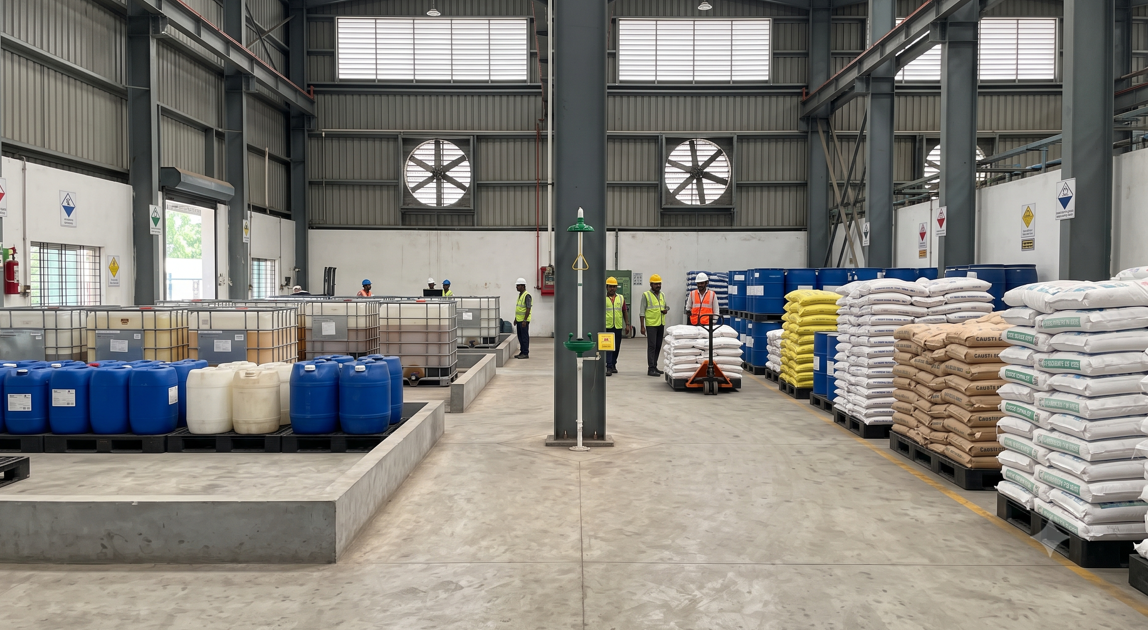
- Storage Segregation: Store carboys in dedicated acid resistant containment pits lined with vinyl ester or FRP. Maintain total physical isolation from flammable chemicals, organic solvents, caustic lyes, and cyanide compounds.
- Mandatory Operator PPE: Personnel handling nitric acid baths must wear full length chemical splash aprons, thick butyl rubber or neoprene gauntlets (nitrile provides poor resistance to high concentrations), chemical safety goggles with a full face shield, and chemical resistant safety gumboots. Keep half mask respirators with combined acid gas and multi vapor cartridges accessible at all times.
Procurement and Logistics: Carboys, Order Planning, and Compliance in Tamil Nadu
Sourcing pickling and passivation acids for manufacturing facilities requires organized ordering cycles, regulatory verification, and secure material handling. When seeking to buy industrial chemicals wholesale, metal finishing operations must balance production volume against licensed chemical warehouse storage limits.
- Packaging Standards: Commercial grade nitric acid is delivered in heavy duty 40 kg or 50 kg unpigmented, UV stabilized, high density polyethylene (HDPE) carboys fitted with threaded caps and tamper evident inner bung seals. For large finishing plants looking for bulk chemical supply in Chennai, shipments can be scheduled in fluorinated polymer lined intermediate bulk containers (IBCs).
- Planning Order Cycles: Nitric acid carboys breathe over time in elevated ambient temperatures. Working with a reliable chemical raw material supplier in Tamil Nadu allows plants to schedule just in time shipments every 30 to 45 days, avoiding container degradation and excessive fuming during hot summer months.
- Documentation and Compliance: Nitric acid distribution complies with statutory Poison Act provisions, requiring buyers and vendors to maintain handling licenses, end user undertakings, and transport documentation. Shipments should always arrive backed by a batch specific Certificate of Analysis (COA) and a 16 section GHS Safety Data Sheet (SDS).
What concentration of nitric acid is used for passivation?
Most industrial passivation specifications, including ASTM A967, call for working nitric acid bath concentrations ranging from 20% to 50% by volume in demineralized water. Fabricators routinely buy nitric acid 68% in bulk technical grade and dilute on site to achieve target bath specifications.
What is the difference between pickling and passivation?
Pickling strips away high temperature welding scale, heat tint, and a measurable depth of the chromium depleted base metal using aggressive acid mixtures containing hydrofluoric, sulfuric, or high concentration nitric acid. Passivation is a non destructive chemical treatment using nitric acid that dissolves free surface iron contaminants and enriches the natural chromium oxide passive layer without altering base metal dimensions.
Can nitric acid damage stainless steel?
Yes. If stainless steel parts are immersed in an incorrectly formulated nitric acid bath with low acid concentration, elevated chloride contamination, or insufficient dissolved oxidisers, the metal can suffer flash attack. Flash attack quickly turns the mirror finished or brushed metal surface dull gray, etched, or pitted. Free machining grades containing added sulfur, such as Type 303, are especially vulnerable and require sodium dichromate additions to inhibit pitting.
How long should stainless steel stay in a nitric bath?
Immersion duration depends on acid concentration, bath temperature, and alloy composition. Standard room temperature baths (21 to 32 degrees Celsius) operating with 20% to 45% nitric acid by volume generally require an immersion time of 30 minutes. Heated baths operating near 50 degrees Celsius can achieve equivalent passivation in 20 minutes. Parts should not remain immersed indefinitely; excessive bath dwell times degrade delicate machined surfaces.
Where can I buy nitric acid in Chennai?
Industrial fabricators and metal finishing shops across Ambattur, Guindy, Sriperumbudur, and Oragadam source certified nitric acid and related processing chemicals directly from Velonex Chemicals, one of the best industrial chemical suppliers in Chennai. For continuous manufacturing lines, plants can buy industrial chemicals in bulk with verified assay certificates, compliant transport documentation, and prompt regional delivery.
