
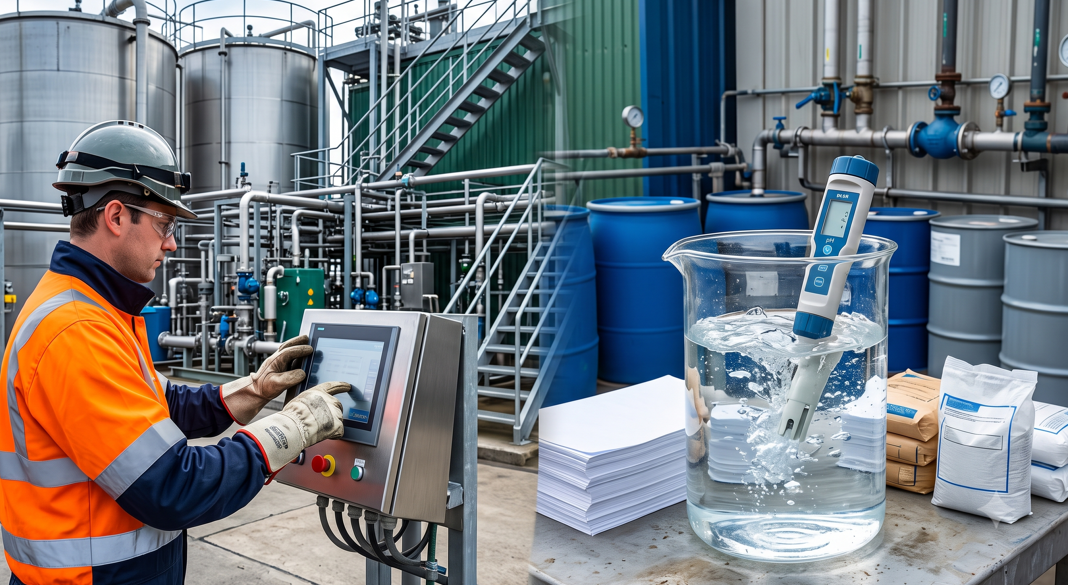
Every industrial wastewater treatment facility relies on chemical balance to function efficiently. Whether you operate an Effluent Treatment Plant (ETP), manage plant chemistry, or oversee environmental health and safety compliance, managing pH is a fundamental requirement. An improper pH level disrupts coagulation, kills active biomass in biological aeration tanks, creates severe pipe corrosion, and leads to regulatory violations with local pollution control authorities like the Tamil Nadu Pollution Control Board (TNPCB) and Central Pollution Control Board (CPCB).
Most plant operators frequently face practical operational questions. Should you increase pH using caustic soda flakes or switch to soda ash? When lowering pH, is hydrochloric acid better suited for your system than sulphuric acid, especially if you run Zero Liquid Discharge (ZLD) units? How do you calculate chemical dosing without repeatedly overshooting your setpoint?
This technical manual details the primary ph adjustment chemicals, compares their operational behavior, outlines the risks of specific anions, and provides a clear titration protocol to calculate exact dosing for full scale treatment tanks.
Why pH Controls Coagulation, Corrosion, and Discharge Compliance
Industrial wastewater streams fluctuate across broad pH ranges. Metal finishing lines dump acidic wash baths, textile dyeing houses release highly alkaline wash liquor, and food processing units discharge variable organic waste streams. Correcting this pH is not merely a formality before discharge. It directly impacts every physical, chemical, and biological stage inside the treatment plant.
Coagulation and Flocculation Window
Inorganic coagulants like alum require precise pH ranges to form dense insoluble hydroxide flocs. Alum typically works within a pH window between 6.0 and 7.5. If the wastewater pH falls below 5.5, aluminum ions stay dissolved in solution, floc formation fails entirely, and turbidity increases in the treated water. Conversely, if pH rises too high, flocs dissolve back into soluble aluminate forms. The same holds true for iron salts like ferrous sulphate or polyaluminium chloride.
Biological Nitrification and Microbial Health
Secondary biological treatment systems depend on living microorganisms. Aerobic bacteria thrive in a narrow pH window between 6.5 and 8.2. Nitrifying bacteria, responsible for converting ammonia into nitrate, consume alkalinity constantly. For every gram of ammonia oxidized to nitrate, approximately 7.14 grams of alkalinity as calcium carbonate is consumed. If you fail to maintain background alkalinity with supplemental bases, the mixed liquor volatile suspended solids (MLVSS) lose activity, the pH crashes, and the biological aeration tank fails.
Heavy Metal Precipitation
Wastewater containing dissolved heavy metals such as copper, nickel, zinc, or lead requires conversion into insoluble metal hydroxides through alkaline precipitation. Each metal precipitates at a distinct minimum solubility pH. For instance, nickel precipitates effectively around pH 9.5 to 10.0, while zinc reaches minimum solubility near pH 9.0 to 9.2. Raising the pH beyond these points can cause amphoteric metals like zinc to resolubilize.
Discharge Limits and Environmental Consent
Pollution control bodies establish strict discharge and zero discharge standards. For inland surface water discharge or public sewer discharge under standard CPCB and State Pollution Control Board consent orders, the acceptable pH limit is strictly defined between 5.5 and 9.0. Operating outside this range triggers statutory penalties, stop work notices, or revocation of Consent to Operate (CTO). Plants operating with reverse osmosis membranes under Zero Liquid Discharge mandates must maintain feed water pH within strict ranges (commonly 6.5 to 7.5) to prevent membrane scaling and premature degradation.
Raising pH: Caustic Soda vs Soda Ash
When wastewater is overly acidic, operators must choose the appropriate alkaline chemical to raise pH. The two primary options used across industrial plants in India are sodium hydroxide (caustic soda) and sodium carbonate (soda ash). Choosing between them requires balancing reaction speed, safety handling, sludge volume, and chemical consumption rates.
| Operational Parameter | Caustic Soda Flakes / Lye (NaOH) | Soda Ash Light / Dense (Na2CO3) |
| Chemical Form | Solid flakes (typically 99% purity) or liquid lye (48% to 50% purity) | Fine white powder / granules (typically 99.2% purity) |
| Alkaline Strength | Very strong base; complete dissociation in water | Moderate base; hydrolyzes in water via carbonate equilibrium |
| Reaction Speed | Immediate, aggressive pH rise | Slower, buffered pH elevation |
| Buffering Capacity | Low; minimal resistance to rapid pH overshoot | High; provides residual bicarbonate and carbonate buffering |
| Safety and Handling | Highly hazardous, severe chemical burn risk, highly exothermic dissolution | Moderately hazardous, irritant to eyes and respiratory tract, mild heat of solution |
| Byproduct Gases | None under normal neutralization reactions | Generates carbon dioxide gas (foaming risk in acidic streams) |
| Alkalinity Equivalent | 1.00 kg pure NaOH provides 1.25 kg CaCO3 equivalent | 1.325 kg pure Na2CO3 matches the neutralization capacity of 1.00 kg pure NaOH |
Caustic Soda Flakes and Lye
Sodium hydroxide provides intense neutralizing power per kilogram. Dissolving caustic soda flakes releases hydroxide ions directly into solution:
NaOHNa++OH-
Because it dissociates completely, caustic soda drives up pH rapidly. This fast response makes it suitable for automated dosing loops with high flow rate equalisation tanks where retention times are short.
However, this aggressive reaction profile is also its primary drawback. Near neutral pH (6.5 to 7.5), the titration curve of a strong base with an unbuffered strong acid is nearly vertical. Adding even a small excess of caustic soda causes the system to swing past pH 7 straight to pH 10 or 11.
Caustic soda flakes generate immense heat when mixed with water. Operators preparing concentrated dosing solutions must add flakes gradually to water with active mechanical agitation. Never dump water on top of dry flakes, as localized boiling can splatter hot caustic solution onto personnel. Personal protective equipment including chemical face shields, PVC apron suits, and heavy rubber gauntlets is mandatory.
Soda Ash Light and Dense
Sodium carbonate works through a two step buffering reaction:
CO32-+H+HCO3-
HCO3-+H+H2CO3H2O+CO2
Soda ash acts as both a neutralizing agent and a chemical buffer. Because it converts into bicarbonate in solution, it resists sharp drops or spikes in pH. This makes soda ash ideal for biological treatment systems that require stable bicarbonate alkalinity to protect nitrifying bacteria.
Soda ash is also substantially safer to handle on the shop floor than caustic soda. While it creates dust that irritates the eyes and respiratory system, it does not inflict rapid, deep chemical burns on skin contact.
The major operational consideration with soda ash is gas generation. When added to high strength acidic waste, the carbonate ions react with hydrogen ions to liberate carbon dioxide gas. In closed neutralization pits or poorly ventilated tanks, this gas release creates dense surface foam that can overflow sumps or cause cavitations in downstream transfer pumps.
Lowering pH: Hydrochloric Acid vs Sulphuric Acid
Effluents from textile washing, caustic degreasing, or chemical bleaching processes often arrive at the treatment plant with alkaline pH values between 9.5 and 13.0. To lower pH prior to coagulation or biological treatment, plant operators rely on mineral acids, primarily hydrochloric acid and sulphuric acid.
Hydrochloric Acid (HCl 30% to 33%)
Hydrochloric acid is a widely used industrial acid for neutralizing alkaline waste:
HCl+OH-H2O+Cl-
Key operational characteristics of hydrochloric acid include:
- Soluble Byproducts: Chlorides formed from neutralization with calcium or sodium salts have exceptionally high solubility. Hydrochloric acid does not generate calcium scaling in tanks, flash mixers, or clarifiers.
- Corrosive Fuming: Commercial 30% to 33% technical grade hydrochloric acid releases pungent, corrosive hydrogen chloride vapors at ambient temperatures. Dosing tanks must use vented acid scrubbers or sealed polyethylene storage tanks with vapor traps to prevent severe rust on surrounding steel walkways, electrical motors, and instruments.
- Chloride Impact on Reverse Osmosis: High chloride concentrations attack standard 304 or 316 stainless steel piping through pitting corrosion. In ZLD facilities, chlorides pass through biological steps and must be treated by membrane processes, where they lower membrane flux and elevate reject water salinity.
Sulphuric Acid (H2SO4 98% Commercial Grade)
Concentrated sulphuric acid is an economical, dense source of acidity:
H2SO4+2OH-2H2O+SO42-
Key operational characteristics of sulphuric acid include:
- High Active Strength: Because technical 98% sulphuric acid is diprotic and concentrated, smaller storage volumes are required compared to commercial hydrochloric acid.
- No Vapor Fuming: Unlike hydrochloric acid, concentrated sulphuric acid does not emit gaseous fumes under ambient storage conditions, making surrounding plant areas easier to maintain.
- Calcium Sulphate (Gypsum) Scaling Risk: If the wastewater contains calcium (common in textile finishing, leather tanneries, or plants utilizing lime), adding sulphuric acid can exceed the solubility product of calcium sulphate (Ksp4.910-5). This precipitates heavy, hard crystalline gypsum scale that clogs dosing injectors, fouls pH sensor glass, and cements clarifier sludge scrapers.
- Sulphate Restrictions in Zero Liquid Discharge: In ZLD plants, high sulphate levels load the downstream evaporator and crystallizer systems heavily. Sulphates also contribute to biological hydrogen sulphide generation in anaerobic holding tanks, creating odors and damaging concrete structures.
Neutralization Matrix: Base and Acid Selection
| Waste Stream Characteristic | Recommended Neutralizer | Primary Reason | Precautions |
| High volume acidic effluent, small mixing tank | Caustic Soda Flakes / Lye | Fast reaction kinetics prevent low pH carryover | Use automated cascade dosing to prevent overshoot |
| Biological feed with low alkalinity | Soda Ash Light | Provides steady bicarbonate buffer for bacteria | Monitor foam creation from released carbon dioxide |
| Hard alkaline effluent containing high calcium | Hydrochloric Acid 33% | Prevents insoluble gypsum scaling across pipes | Maintain vapor seals and anti corrosion piping |
| Unbuffered alkaline waste in standard ETP | Sulphuric Acid 98% | Cost effective per mole of hydrogen ion delivered | Check calcium concentrations to avoid scaling |
How to Set the Dose: From Bench Titration to Full Scale Neutralization Tank
Setting a chemical dose cannot be done by relying on theoretical formula balances alone. Industrial wastewater contains organic acids, residual detergents, weak salts, and dissolved carbonates that introduce complex background buffer systems.
A pH reading tells you solely the free hydrogen ion concentration. It does not reveal how much acid or base is required to shift that value. Setting the correct chemical feed rate requires conducting a benchtop acid base titration curve on a representative effluent sample.
Step 1: Laboratory Bench Titration Protocol
- Collect a representative, well mixed 1000 mL (1 liter) sample of the raw wastewater in a glass beaker.
- Place the beaker on a magnetic stirrer with a calibrated laboratory pH meter submerged into the vortex. Record initial sample temperature and pH.
- Prepare a standardized working reagent solution:
- For acidic effluent: Prepare a 1.0% weight by volume sodium hydroxide solution (dissolve exactly 10.0 grams of caustic soda flakes into distilled water and make up to 1000 mL). Each milliliter of this reagent contains 0.01 grams of pure NaOH.
- For alkaline effluent: Prepare a 1.0% volume by volume sulphuric acid or hydrochloric acid working solution.
- Using an analytical 50 mL burette, titrate the working solution into the 1000 mL effluent sample in small increments:
- Add 0.5 mL to 1.0 mL increments initially.
- Allow the stirrer to blend the solution for 30 to 45 seconds until the pH sensor output stabilizes.
- Record the cumulative volume added alongside the resulting pH.
- Continue titrating until your effluent reaches the target setpoint (typically pH 7.2 to 7.5 for coagulation, or 7.0 for neutral discharge).
- Note the exact total volume of reagent (Vbench in mL) needed to reach the target pH.
Step 2: Full Scale Tank Dosing Calculation
Once you know the bench dosage, calculate the full scale commercial chemical requirement using the following scaling formulas.
Formula for Caustic Soda Dosing
NaOHrequired(kg)=VbenchCstockVtank1000Purity
Where:
- Vbench = Volume of 1.0% caustic solution used on the 1 liter sample (in mL)
- Cstock = Concentration of bench reagent ($0.01 \text{ kg NaOH per liter of 1\% reagent}$)
- Vtank = Volume of wastewater to be treated in the equalization pit or batch tank (in m3)
- Purity = Fraction of purity of the commercial chemical (for technical flakes, typically 0.98 to 0.99)
Practical Worked Example
- Target: Raise an equalisation tank containing 50m3 of acidic pickling wash from pH 3.2 to pH 7.0.
- Bench Result: A 1000 mL sample required 14.5 mL of 1% NaOH solution to stabilize at pH 7.0.
- Commercial Chemical: Technical grade caustic soda flakes (99% pure).
Cbench=14.5mL0.01g/mL1L=0.145g/L=0.145kg/m3
CommercialFlakesRequired=0.145kg/m350m30.99=7.32kgofCausticSodaFlakes
To dose this safely into the tank:
- Slurry the 7.32 kg of flakes into an external chemical preparation tank filled with clean industrial water.
- Run the dosing pump progressively into the neutralization zone under continuous mechanical mixing.
- Allow one full retention turnover before final discharge verification.
Common Operating Mistakes in Effluent Neutralization
Even when chemical selections are made correctly, day to day plant execution frequently runs into mechanical and chemical errors that degrade performance.
1. Dosing Chemicals Ahead of Complete Mixing
Adding concentrated caustic lye or acid directly into an unmixed tank creates severe stratification. High density chemicals like 98% sulphuric acid sink directly to the tank floor, corroding tank bottom plates and failing to contact the bulk fluid. Ensure your dosing pipe drops chemical directly into the turbulence zone created by a high efficiency mixer or right above an air sparging grid.
2. Hunting and Setpoint Overshooting
In automated continuous neutralization systems, operators frequently see the pH hunt cyclically between pH 4 and pH 10. This occurs when the dosing control valve response time is faster than the retention and mixing time of the tank. When the probe reads pH 5, the pump dumps excessive caustic soda. By the time the fluid mixes and hits the sensor, the pH has shot past 9. Tune PID loop controller gains down, introduce split range dosing, or employ dual stage neutralization tanks (Stage 1 brings pH from 3 to 5.5; Stage 2 fine tunes from 5.5 to 7.2).
3. Neglecting Natural System Buffering
Operators often assume that shifting wastewater from pH 4 to pH 5 requires the same amount of chemical as shifting it from pH 5 to pH 6. Because pH is a logarithmic scale of hydrogen ion activity, each single unit shift represents a tenfold change in ion concentration. Furthermore, weak base buffers like phosphates and carbonates flatten the titration curve over specific ranges, consuming chemical without showing immediate pH movement, followed by a sudden spike once the buffer capacity breaks down.
4. Poor pH Electrode Maintenance
In wastewater containing suspended solids, organic grease, and heavy metals, glass bulb electrodes foul rapidly. A coating of oil or metal hydroxide sludge insulates the sensing glass, creating slow response times (time lag). The controller continues to dose chemicals because the sensor has not yet registered the change. Implement weekly sensor cleaning using mild hydrochloric acid washes followed by two point calibration with fresh buffer solutions (pH 4.01, 7.00, and 9.20).
Frequently Asked Questions
Which chemical increases the pH of water most efficiently?
Sodium hydroxide (caustic soda) increases the pH of water most rapidly and with the lowest chemical weight requirement. Because it dissociates completely into sodium and hydroxide ions, it neutralizes acids instantly without creating foaming or requiring complex secondary dissolution steps.
How do I lower the pH in industrial effluent?
To lower wastewater pH, introduce a dilute stream of mineral acid, typically commercial hydrochloric acid (30% to 33%) or sulphuric acid (98%). Hydrochloric acid is preferred when you must avoid calcium sulphate scaling or when working with high calcium water. Sulphuric acid is preferred for high volume operations seeking lower shipping and inventory volumes.
Is soda ash safer than caustic soda for plant operators?
Yes. Soda ash (sodium carbonate) is significantly less aggressive to human skin and eyes than caustic soda. Caustic soda causes rapid chemical liquefaction of skin tissues upon contact and releases intense heat when mixed with water. Soda ash poses a dust irritation risk but will not generate severe exothermic reactions or violent skin burns under standard operating concentrations.
How much caustic soda is required to raise the pH by 1 unit?
Because pH is a logarithmic measurement and wastewater contains variable natural buffering agents (like carbonates, humic acids, and phosphates), there is no fixed universal quantity of caustic soda to raise pH by 1 unit. You must carry out a laboratory bench titration on a 1 liter sample using a 1% caustic solution to determine the specific buffer capacity of your factory effluent.
Why does my effluent pH keep drifting after chemical correction?
Post correction pH drift is usually caused by three factors: incomplete initial mixing, chemical degasification, or slow dissolution of suspended solids. If wastewater contains high levels of dissolved carbon dioxide from soda ash dosing, the CO2 slowly off gases to the atmosphere over several hours, causing the pH to drift upward naturally. Alternatively, if slow dissolving alkaline or acidic flocs are present in the equalization tank, their progressive dissolution will continuously alter the liquid phase equilibrium.
For reliable plant operations, ensure your treatment line uses industrial grade caustic soda flakes, high purity soda ash, hydrochloric acid, and technical sulphuric acid supplied to consistent concentration standards. To discuss specific dosing requirements, request material safety data sheets, or procure bulk consignments for your facility, contact our chemical technical team through the Velonex Chemicals Contact Page or explore our complete line of industrial treatment reagents on the Velonex Chemicals Products Page.
